Based on patient education videos by John Vacovec, PT, founder of Physical Therapy & Sports Rehab. Reviewed by John Vacovec, PT, November 2026.
When your lower back hurts, try sleeping on your back with a pillow under your knees, or on your side with a pillow between your knees. Most people have tried these, and both are a good place to start, because supporting your spine in a more natural position always matters. Often, though, it is not enough on its own.
There is no one best position for everyone. Try the ideas below for a couple of nights each, and keep what helps. This guide also explains why a sore back can feel worse at night or in the morning, how to get out of bed more easily, three gentle exercises from John Vacovec, PT, and which signs mean you should call a doctor.
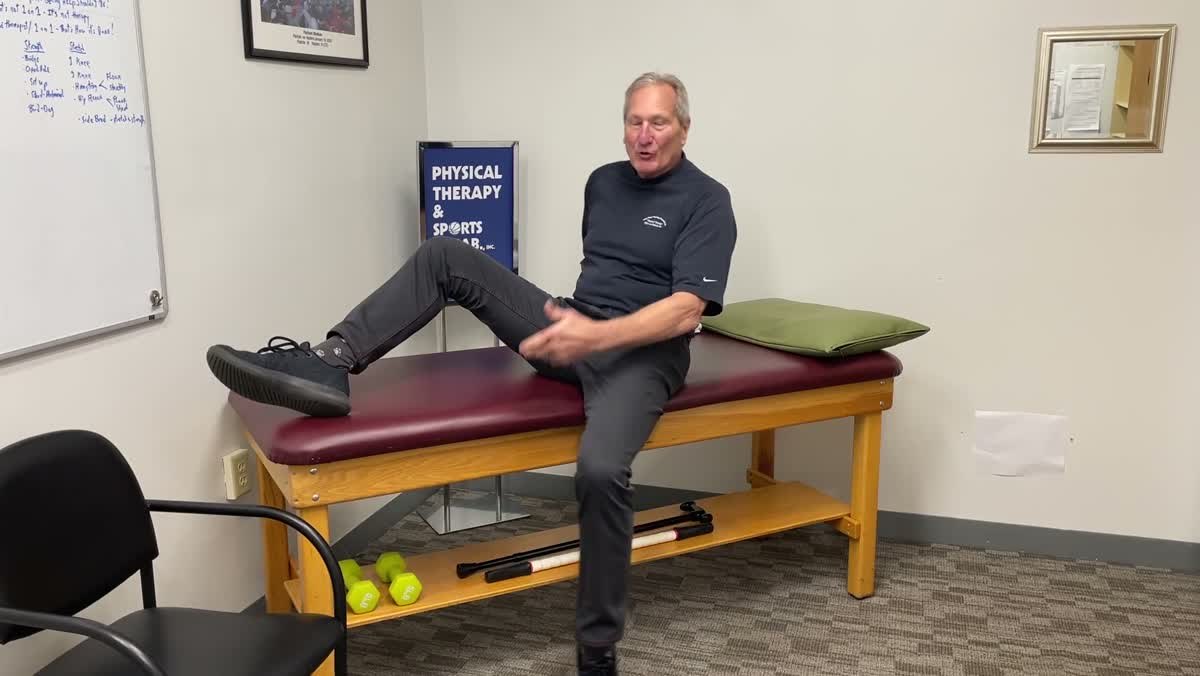
Why does my lower back hurt in bed or when I wake up?
Most joints like movement. Movement keeps a joint lubricated and helps it exchange fluid. When you lie still for hours, that lubrication drops, and the nerve endings in the joint start letting you know they are unhappy. The discomfort usually builds slowly. If you feel better once you are up and moving, that can point to a long-term (chronic) problem, which needs a different plan than a new injury.
The way you lie can also strain the muscles, ligaments and joint surfaces. And pain makes it hard to sleep, while poor sleep makes pain feel worse. Common reasons include:
- Your sleep position. Some positions hold your spine out of its natural alignment for hours. That can squeeze joint surfaces together and keep a low, steady pull on tissue that may already be tight, irritated or inflamed.
- Not moving for seven or eight hours. Stiffness sets in, and moving in the morning can hurt at first, then feel better.
- A mattress that sags, is too soft or is too old.
- Always sleeping on the same side of the bed. Your body rests in the same positions night after night. Over many years, that can leave some joints, ligaments and muscles tight and others overstretched.
- A health problem. Arthritis in the spine, disk problems, numbness, tingling or pain running down your leg, and spinal stenosis can all play a part in morning back pain.
Back pain that is worse when you lie down, or that wakes you up at night, is a reason to contact your medical doctor or physical therapist right away. Other warning signs are listed near the end of this guide.
What is the best sleeping position for lower back pain?
For most people, sleeping on the back or the side is easiest on the lower back, with a pillow in the right spot. Here is how to set up each one.
On your back
- Lie on your back with a pillow that keeps your head level. Your chin should not point up at the ceiling or down at your chest.
- Put a pillow or a rolled towel under your knees.
- Keep both arms in the same position, by your sides or resting on your stomach, instead of flinging one arm over your head. A small pillow under both arms can add comfort.
Why the pillow under your knees? When your legs lie flat, your lower back can arch too much, especially if the muscles at the back and front of your thighs are tight. That can squeeze the small facet joints in your back and cause pain. Some people also like a small pillow or rolled towel under the small of the back.
If you have sleep apnea, do not ignore it. Talk to your medical doctor, including about which sleeping position is right for you.
On your side
- Lie on your side with your knees bent slightly.
- Put a pillow between your knees.
- Use a head pillow thick enough to keep your head and neck level, so your head does not droop down.
- You can also try a very thin pillow or folded towel under your rib cage, on the side touching the bed. It helps support your ribs and spine, especially on an old or sagging bed.
The pillow between your knees keeps your top leg from sliding forward and twisting your body. A pillow in front of you can stop you from rolling onto your stomach. If you can, switch sides now and then.
Try not to curl up into a tight ball with your knees pulled to your chest. It often feels good, because the stretch on the muscles and soft tissue overrides the pain signals for a while. But as soon as you come out of that position, the pain usually comes back stronger.
On your stomach
Stomach sleeping is often hard on a sore back and neck. If it is the only way you can fall asleep, put a thin pillow under your lower stomach, and use a very thin head pillow or none.
What kind of mattress and pillow help a sore lower back?
There is no single best mattress for everyone, and people spend a lot of money looking for the right mattress and pillow. A good place to start is one that feels firm and supportive but not hard, so you don't sink into it.
- Look for medium firm. Many experts suggest medium firm for back pain. Lie on it before you buy, and check the return policy.
- Go with comfort. If you have always slept on a soft bed, a much firmer one may feel worse at first. It now holds your spine and joints in positions they have not been in for years, and your body will let you know.
- Replace it when it is worn. A general rule is every six to eight years, or sooner if it sags, or if your back feels stiff at home but not when you sleep somewhere else.
- Pick pillows for the way you sleep. Again, there is no one answer. Side sleepers need a thicker head pillow than back sleepers. Stomach sleepers need a very thin one, or none.
How do I get out of bed with lower back pain?
Roll onto your side first, then use your arms to push yourself up. This is often called a log roll, and it helps you avoid bending forward at the waist.
- Turn onto your side.
- Draw up both knees.
- Swing your legs over the side of the bed.
- Push yourself up to sitting with your hands.
- Sit on the edge of the bed for a moment and let your back settle.
- Stand up using your legs, not your back.
- Stay standing for a count of 10 or 15 and get your bearings before you take your first step. This is good for safety, and it lets your joints settle into a weight-bearing position.
To get into bed, do the same steps in reverse.
What helps with lower back stiffness in the morning?
Take a few minutes to get your back ready before you get up, with some gentle stretching in bed.
- Stretch while you are still in bed. Lying on your back, bring one knee toward your chest, then switch legs. John shows how to do this below.
- Heat or ice? Both are good, and John is partial to ice. Ice can ease pain and swelling, quiet the nerves carrying pain, and bring more blood flow and nutrients to help the area heal. Heat is usually more comfortable and can help with stiffness and muscle spasms. Wrap the pack in a towel so it does not touch your skin, leave it on for 12 to 15 minutes, and check your skin often.
- A menthol rub. A topical such as StoPain, with 10% menthol, floods the nerves with cooling signals that compete with the pain signals going to the spinal cord, so less pain gets through. The smell may not suit bedtime, but it is a good way to start the morning.
- Get ready the night before. Gentle stretching or a warm shower before bed can help you relax.
Which gentle stretches can help a stiff lower back?
John shows these three in his videos. You can do them on your bed or on the floor. Please check with your physical therapist before you start any new exercise. Move slowly and gently. Stop if your pain gets worse or if you feel numbness or tingling.
As John says in his video, "You don't want to overstretch and you don't want to bounce." Ease into each stretch and hold it.
1. Single knee to chest
John calls this one so common that everybody talks about it. It is a gentle stretch for your lower back and buttock.
- Lie on your back on your bed or the floor, with a pillow under your head if you like.
- Bring one knee toward your chest and hold it with your hands. Keep your other leg straight down on the bed. A common mistake is letting that knee pop up.
- Hold for a slow count of 20 to 30 seconds, then bring your foot back down.
- Do 3 or 4 on each side.
If you can't reach your knee, loop a towel or a belt behind it to help.
2. Double knee to chest
The next step: both knees at once.
- Lie on your back with your knees bent, then bring both knees toward your chest and hold them.
- Hold for 20 to 30 seconds, then lower your feet slowly, one at a time.
- Do 3 or 4, as it feels comfortable.
John's tip: if you can't get your knees up that high, put a towel over your legs and hold the ends. And don't bounce. Bouncing feels like you are going further, "but you're not."

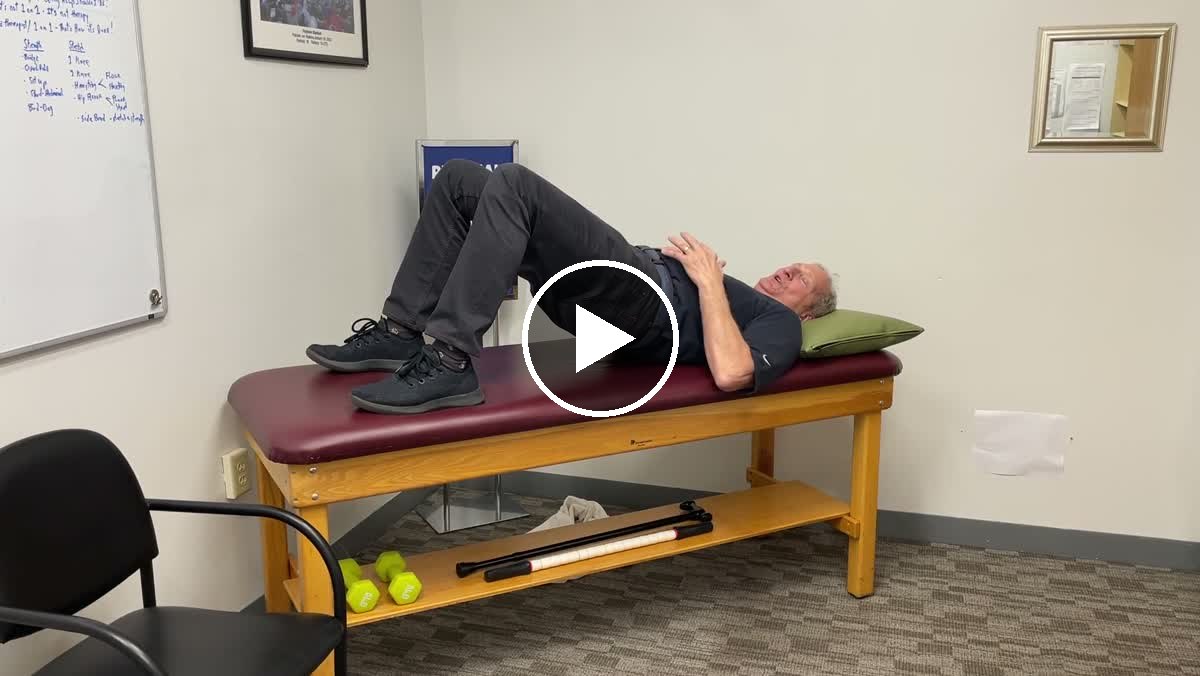
3. Bridge
The bridge is a strengthening exercise, not a stretch. John says it is great for the muscles that help steady your spine.
- Lie on your back with your knees bent and your feet flat.
- Slowly lift your hips off the bed or floor and hold for a count of 10.
- Lower your hips back down and relax.
- Start with a few, as it feels comfortable.
Once the bridge feels easy, John shows a harder version with one leg straight. Ask your physical therapist before you try it.
This guide is about sleep. For more back exercises, see our article on physical therapy strategies for low back pain.
Can physical therapy help lower back pain that affects your sleep?
Yes. "In my 40+ years as a treating therapist," John says, "I would pick mobility and tightness as the leading cause of muscle and joint pain. Most people don't like stretching." Joints get stiff, the tissue around them gets tight, and that squeezes the joints together.
Physical therapists help people with lower back pain move better and hurt less. We are Doctors of Physical Therapy who combine hands-on treatment with exercise to relieve pain, restore motion and get you back to the things you like to do. That care includes teaching good positions for sleeping, sitting and lifting.
Your therapist will ask about your health and symptoms, look at how you move, and plan your care. It may include:
- Hands-on care to help stiff joints and muscles move better
- Stretching and strength exercises chosen for your body and your goals
- Advice on positions for sleeping, sitting, lifting and bending
Our 4 Phase Treatment Approach
- Phase I: Getting pain and inflammation under control.
- Phase II: Improving your motion and mobility without aggravating your pain.
- Phase III: Improving strength and core stability to protect you and prevent future injuries.
- Phase IV: Building your strength and endurance to a higher level, so you can get through the day or work without tiring, with more confidence and a lower risk of reinjury.
A view from above: what sets us apart
People should not have to wait, guess or struggle when dealing with pain, post-surgery recovery or movement issues. At Physical Therapy & Sports Rehab (PT&SR), in practice since 1983, we make it easy:
- Quick access: seen within 10 business days or less
- The same therapist, every visit
- One-on-one treatment: your session is never shared or rushed
- 400+ five-star reviews
- 60% of our patients are returning or referred by family and friends
- 40+ years of independent private practice
You can read more about how we treat neck and back pain. If a sore shoulder also keeps you up, see our guide to sleeping with shoulder pain.
When should you see a doctor first?
Most lower back pain is not an emergency, and it often gets better within a few weeks. But some signs should not wait.
Call 911 or go to the emergency room if you have back pain and any of these:
- Numbness or a loss of feeling around your genitals, bottom or inner thighs
- New trouble peeing, or losing control of your bladder or bowels
- Pain, tingling, weakness or numbness in both legs
- Chest pain
- Pain that started after a serious accident, such as a car accident
The first three can be signs of cauda equina syndrome. This is a rare but serious problem where the nerves at the bottom of the spine are squeezed, and it needs care right away.
Contact your doctor right away if you have:
- Back pain with a fever, or if you feel hot, cold, shivery or unwell
- Back pain after a bad fall or a hard blow
- Weakness or numbness in your buttock, thigh, leg or pelvis
- Pain that travels down your leg below the knee
- Pain that is worse when you lie down, or that wakes you up at night
- Severe pain that does not let you get comfortable
- Trouble walking or keeping your balance
- Burning when you pee, or blood in your urine
- A history of cancer, or weight loss without trying
Make an appointment if your pain does not start to ease after a few weeks of home care, if it keeps you from your daily activities, or if your back hurts most mornings for two or three months.
Sleeping with lower back pain FAQs
Should I rest in bed or keep moving when my back hurts?
Keep moving as much as you comfortably can. Staying in bed for long periods is not recommended for back pain, and gentle activity, like walking, is usually better. You may need to take it easier for the first day or two, then slowly get back to your normal routine.
Do I need a doctor's referral for physical therapy in Massachusetts?
No. You can see a physical therapist in Massachusetts without a doctor's referral, but some insurance plans may require one. Call us at (781) 769-2040 and we can check your plan, or read our article on physical therapy without a referral.
Book a visit in Norwood or Norfolk
If your lower back keeps waking you up, you don't have to just live with it. We would be glad to help you get back to a good night's sleep. Visit our Norwood and Norfolk clinics, call (781) 769-2040 or book online.
Sources
- MedlinePlus: Low back pain, acute
- NHS: Back pain
- Cleveland Clinic: Best sleeping positions for pain
- Cleveland Clinic: Why your lower back pain is worse in the morning
- Cleveland Clinic: Low back pain coping tips
- Cleveland Clinic: How to choose a mattress
- Cleveland Clinic: Cauda equina syndrome
- APTA ChoosePT: Physical therapy guide to low back pain