Based on patient education videos by John Vacovec, PT, founder of Physical Therapy & Sports Rehab. Reviewed by John Vacovec, PT, November 2026.
Your neck and shoulders often hurt together because they share muscles. Some of the muscles in your neck run all the way down to your shoulder blade. So when one spot gets tight, it pulls on the other.
Most of the time, this starts with normal, everyday things, like how you sit at work or how you sleep. Physical therapy can often help. A physical therapist finds out what is causing your pain, then works on your neck and shoulders together.
In this guide, we will explain why this happens in plain English. You will also see five exercises from our founder, John Vacovec, PT, and learn when you should call a doctor.

How are your neck and shoulders connected?
Muscles tie them together. Picture the ropes that hold up a tent. If you pull one rope too tight, the whole tent shifts. Your neck and shoulders work in much the same way.
Two muscles do a lot of this work:
- The trapezius (say "trah-PEE-zee-us"). This is the large muscle across the top of your shoulders. It starts at the base of your skull and spreads out over your upper back.
- The levator scapulae (say "leh-VAY-ter SCAP-you-lee"). This one runs from the upper part of your neck down to your shoulder blade.
John likes to call your shoulder blade your "wing bone." It is the flat bone you can feel on your upper back. It is not locked in place. Muscles along your spine hold it close to your body, and it slides around each time you lift your arm.
You can feel this link yourself. Put your right hand on top of your left shoulder, close to your neck. Now shrug your left shoulder up and down. The muscle you feel moving under your fingers goes all the way up to your head.
The front of your body matters too. Your chest muscles tend to pull your shoulders forward. When your shoulders roll forward, your head moves forward with them. Then the muscles at the back of your neck have to work harder to hold your head up. As John says in his video, "the neck, head and shoulder are so connected."
What does neck and shoulder pain feel like?
It is different for each person. You may notice:
- A stiff neck that is hard to turn to one side
- A tight, achy band across the tops of your shoulders
- A sore spot near your shoulder blade
- A headache that seems to start at the base of your head
- Pain that travels down your arm, or numb and tingly fingers (please have this checked, and see the doctor section below)
What causes neck and shoulder pain at the same time?
Muscle strain or tension from daily life is a common cause. Here are the things that most often set it off.
Long hours at a desk
Think about a normal workday. You sit down feeling fine. An hour later, you are leaning in toward the screen. Your head has moved forward and your shoulders have rolled in. Your muscles have been holding that position the whole time, and by the end of the day they are tired. A screen that sits too high or too low makes this worse. Our guide to tech neck has more on phones and screens.
The way you sleep
You spend hours in one position at night. If your neck is twisted or your pillow holds your head at an odd angle, you can wake up stiff and sore, often on one side.
Lifting
Picking up something heavy too fast, or with your body in a poor position, can strain the muscles in both areas.
A pinched nerve in your neck
Nerves leave your neck and travel down into your arm. If one gets squeezed or irritated, you may feel pain in your shoulder or arm, even though the trouble starts in your neck. You may also feel numbness or weakness.
A sore or injured shoulder
When your shoulder hurts, you may start moving in a different way to protect it. Your neck muscles can end up doing extra work, and then they get sore too.
Can physical therapy help neck and shoulder pain?
Yes. Physical therapy is often a good first step when the pain comes from your muscles, joints or posture. Posture simply means how you hold your body when you sit and stand.
A physical therapist does more than treat the spot that hurts. Since these two areas work as a team, we look at both, even if only one is sore. Your plan may include:
- Hands-on care. Your therapist uses their hands to loosen tight muscles and help stiff joints move better.
- Exercises for motion. These help you turn your head and lift your arm more easily.
- Exercises for strength. Stronger muscles around your shoulder blades help hold you up so your neck does not have to do it alone.
- Posture coaching. You learn better ways to sit, stand and work, and how to keep it up at home.
You can read more about how we treat neck pain and shoulder pain.
What happens at your first visit?
Your first visit is a one-on-one evaluation with a physical therapist. We will ask what happened and what matters most to you, like getting back to golf or just sleeping better. Then we check how your neck and shoulders move, and where you are tight or weak. Before you leave, we explain your plan in words that make sense to you. If you have any imaging reports, like an X-ray or MRI report, bring them along.
At Physical Therapy & Sports Rehab (PT&SR), you work with the same physical therapist at every visit. If your therapist finds something that needs a doctor's attention, they will tell you and can work with your doctor.
Which exercises help a tight neck and shoulders?
John shows these five in his videos. Please check with your physical therapist before you start any new exercise. Move slowly and gently. Stop if your pain gets worse or if you feel numbness or tingling.
1. Shoulder shrugs
This is a good place to start, because so many of the muscles from your shoulders come up and attach to the base of your head.
- Stand or sit up tall.
- Bring your shoulders all the way up to your ears.
- Let them come all the way back down.
- Start with about 10.
Don't worry about whether your shoulders are going forward or rolling. Just go all the way up and all the way down.
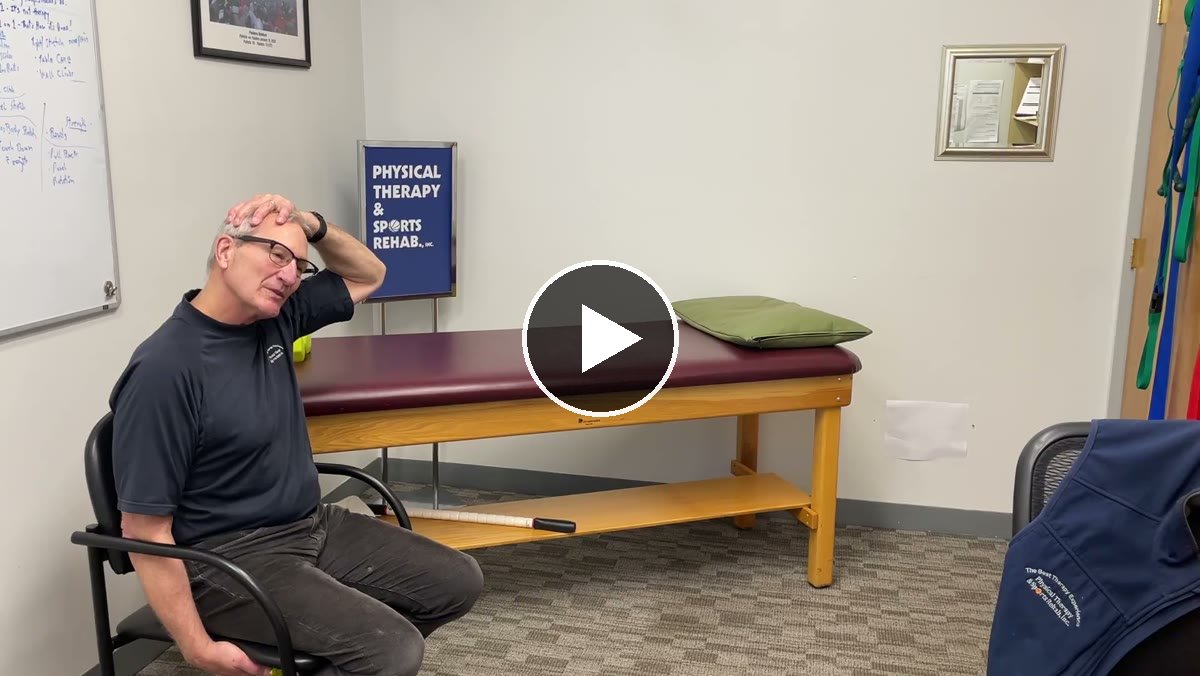
2. Side neck stretch with your hand
- Sit down and anchor one shoulder by keeping that arm low at your side.
- Put your other hand on top of your head.
- Gently bend your head away from the anchored shoulder and count to 10.
- Keep your hand on your head as you come back up.
- Do 3 on each side.
John's tip: don't let go and let your head snap back up. Your hand should guide it the whole way.
3. Doorway chest stretch
This one opens up the chest muscles that pull your head and neck forward.
- Find an open doorway or the corner of a room.
- Put one hand on each side.
- Lean in gently until you feel a stretch across your chest.
- Hold, then step back.

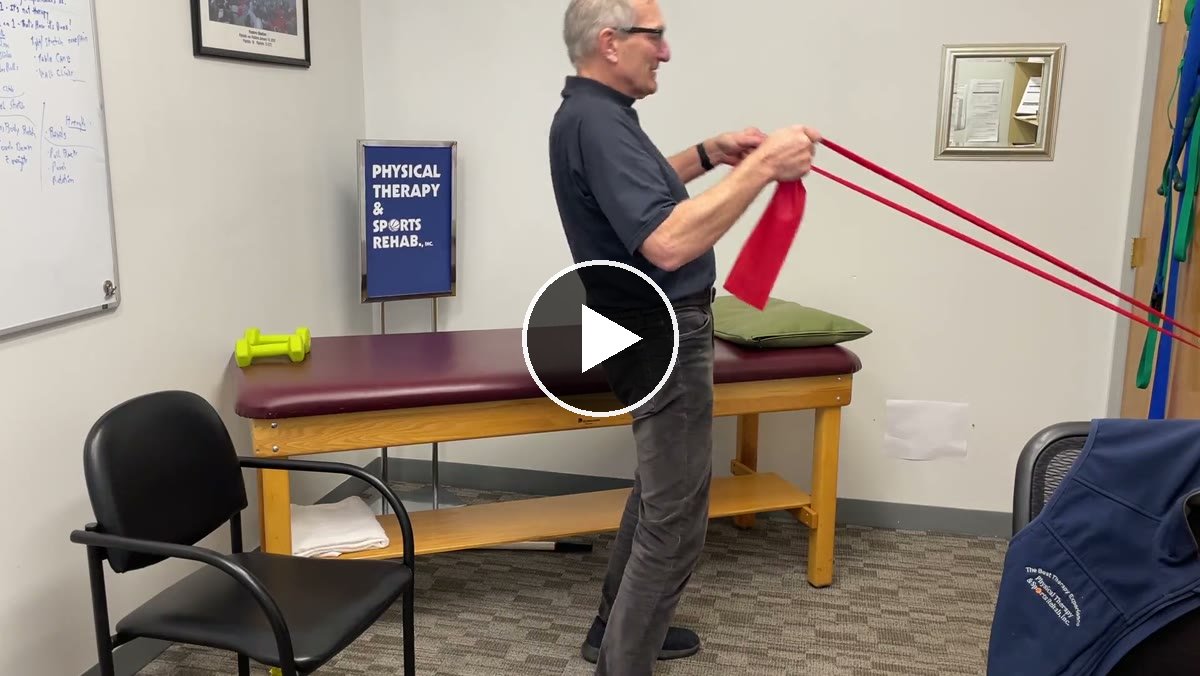
4. Resistance band rows
This builds up the muscles around your shoulder blades. You will need a stretchy exercise band.
- Anchor the band in a door.
- Stand with your feet firmly planted.
- Keep your back still.
- Pull the band back, using the muscles between your shoulder blades.
- Slowly let it go forward again.
The key is to keep your back steady. Your shoulder blades should do the work.
5. Wall posture check
This one shows you how you are really standing.
- Stand with your heels a little away from a wall.
- Try to touch the wall with your buttocks, your shoulder blades and the back of your head.
- Notice what happens. Your buttocks may touch while your head stays forward, or your head may touch while your hips drift away.
Don't try to get it all at once. As John says, it takes a while.
What can you change at your desk and in bed?
Small habits add up over a day. Try these:
- Sit tall. Roll your shoulders back gently and bring your neck back.
- Move often. Don't hold your neck in the same position for a long time. Get up, or at least shift how you sit.
- Check your pillow. A low, firm pillow helps keep your head level with the rest of your body.
- Try not to sleep on your stomach. Your neck has to stay turned to one side all night.
- Use heat or cold. Wrap a heat or cold pack in a towel and place it on the sore area.
When should you see a doctor first?
Most neck and shoulder pain is not an emergency. But some signs should not wait.
Call 911 if neck, shoulder, arm or jaw pain comes with shortness of breath, sweating, nausea or vomiting. These can be signs of a heart attack. Also call 911 if you have a fever and a headache, and your neck is so stiff that you cannot touch your chin to your chest.
Contact your doctor if you have:
- Numbness, tingling or weakness in your arm or hand
- Pain that started after a fall, a blow or another injury
- Pain that gets worse when you lie down or wakes you up at night
- Trouble swallowing, breathing, walking or keeping your balance
- Loss of control over your bladder or bowels
- Symptoms that do not go away after a week of self-care
Neck and shoulder pain FAQs
Why do my neck and shoulders hurt when I wake up?
The way you sleep is a common reason. Your neck can stay in an awkward position for hours, especially if you sleep on your stomach or your pillow holds your head too high. A low, firm pillow that keeps your head level often helps.
Can a neck problem cause shoulder pain?
Yes. A pinched nerve in your neck can send pain into your shoulder or arm, sometimes with numbness or weakness. A physical therapist can check your neck and shoulder together to help find where the pain is coming from.
Can tight neck and shoulders cause headaches?
They can play a role. The muscles that run from the base of your head to your shoulder blade are affected by how you sit and stand. If you get headaches along with neck tension, tell your physical therapist so they can check those muscles and your posture.
Do I need a doctor's referral for physical therapy in Massachusetts?
No. You can see a physical therapist in Massachusetts without a doctor's referral, but some insurance plans may require one. You can read more in our article on physical therapy without a referral.
How long does neck and shoulder pain take to get better?
It depends on the cause. Most neck pain lasts only a few weeks, but pain that keeps coming back or spreads into your arm may take longer. Your physical therapist will explain what to expect after your first visit.
Book a visit in Norwood or Norfolk
If your neck and shoulders keep bothering you, you don't have to just live with it. We would be glad to take a look at both. Visit our Norwood and Norfolk clinics, call (781) 769-2040 or book online.